Author:

Last 8 February Super Bowl half-time show of the artist Bad Bunny not only caught the world's attention as the first Latin American artist to perform and sing primarily in Spanish language within this sports show history, but updated the debate on how music and politics are strongly connected, and shape our social experiences (of everyday life). Moreover, the mise-en-scène exposed a deeper and more complex understanding of music's powers in influencing social structure. At first sight, by displaying to the world Puerto Rico’s present and Latin-American immigrant communities’ circumstances under the current Trump administration. Mostly by encouraging the audience to redefine concepts that create belonging, such as the meaning of ‘America’, thus inscribing their musical performance in contemporary “cultural battles”.
The performance drew 128.2 million viewers on, and set a record for social media views with over 4.16 billion cross-platform views in 24 hours. However, the Super Bowl halftime show by Bad Bunny was not the first attempt by a Puerto Rican musician to reach a global audience with the aim of spreading a message about integration, while also featuring national attributes. Leaving aside the differences among globalisation’s historical processes, Trinidad (Trina) Padilla de Sanz (1864-1957), a Puerto Rican poet, suffragette, teacher and composer, addressed, more than a hundred years ago, the question of national and transnational identities simultaneously. During her lifetime, she raised her voice at defining moments in Puerto Rico’s history and participated in Latin- (or “South” as we will see below) American cultural and intellectual debates. Using the pen name “La Hija del Caribe”, adopted in honour of her father, José Gualberto Padilla, a prominent medic, poet, and political activist known as “El Caribe”, she signed articles, essays, poems, and short stories on a variety of topics, which were published in journals worldwide.
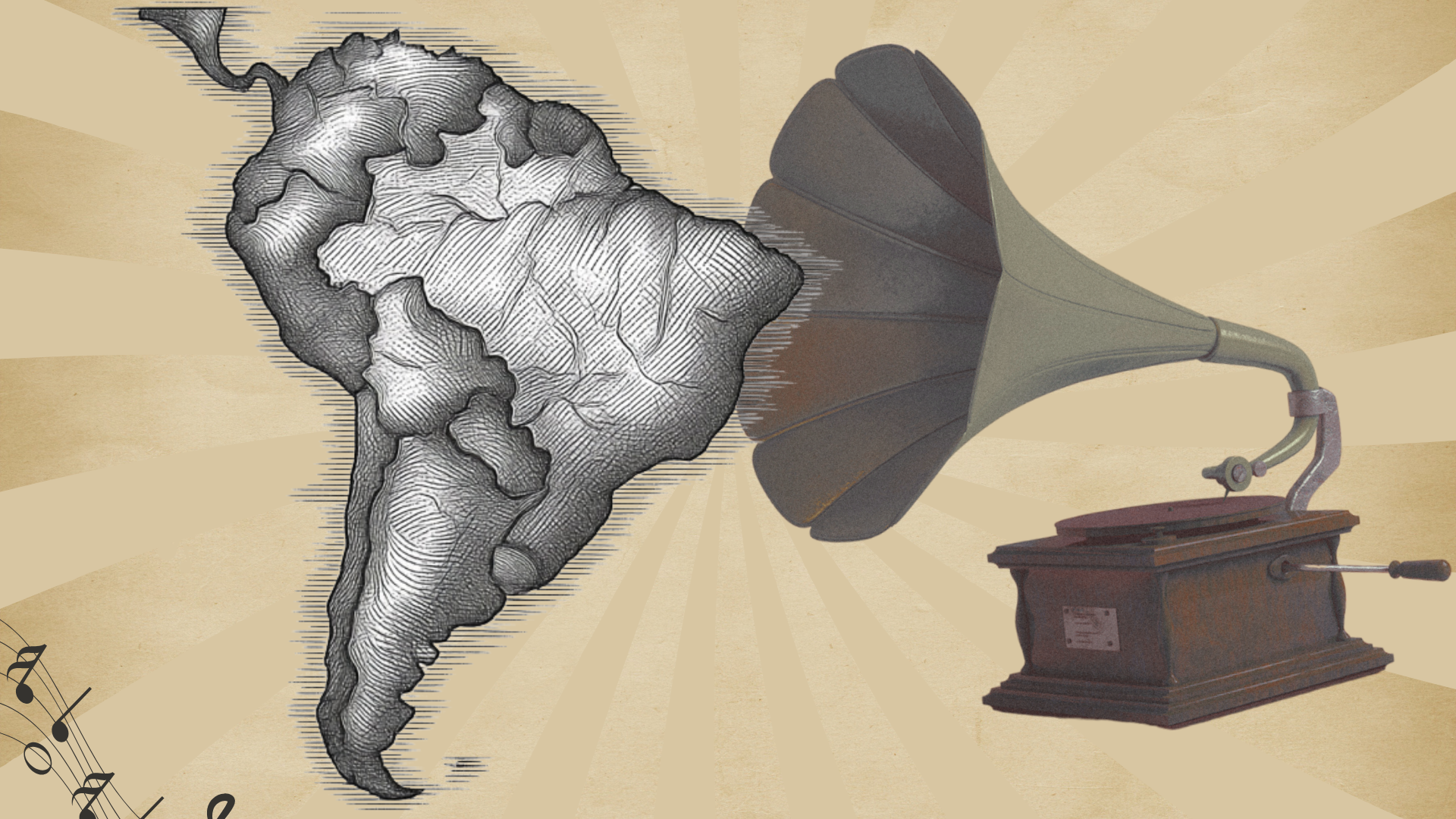
One of these journals was the Correo Musical Sud-Americano (something like “South American Musical Courier”) edited in Buenos Aires, Argentina, during the First World War. This publication was probably the first of its kind –a Latin American transnational musical magazine– to attempt and succeed in transcending borders in a war context, by establishing distribution channels of almost global reach, within the traditional areas of European transculturation. Among them were the Italian cities of Milan, Bologna, Rome, Turin, and Naples.
“La Hija del Caribe” played an important role not only in writing for the magazine Correo…, but also as the only woman on its editorial team. The initial exploration of the editorial times or vital moments of the magazine during 1915, revealed us a twist on the imaginaries of its managing groups during the First World War: from an ideal of reforming musical practices under a sort of cultural paradigm mostly connected with the north American nineteen century European culture translation, to an ideal of "americanismo musical" (musical Americanism) where ‘America’ is understood exclusively as "south America" with Caribbean areas on them.
The case of Trina Padilla de Sanz –and many others who published at times when women were struggling for their emancipation– allows us to address women's agency in national and transnational identity-building processes. In this sense, preliminary comparisons of contributions of women’s writings in Italian musical journals, such as La Riforma Musicale and La Nuova Musica, with the Correo Musical Sud-Americano, show some shared patrons with regard to professional profiles (a major presence of female pianists) but differences in their national origins and subjects addressed by them.
While the female writers in the Italian music press were predominantly—as far as we know—of Italian origin, those who contributed to journals such as Correo Musical Sud-Americano and others came from various countries in Latin America and Europe. The former focused mainly on developing pedagogical treatises and enriching national musical culture (for example, by reviewing local performances and the repertoires of salon concerts). The latter, on the other hand, exhibited a broader range of writing, from the importance of relationships with women for musicians within the classical canon to reviews of the works of Latin American and European female composers, or the publication of the latter's reflections on their own interpretations.
As an example of the Latin American journals, the aforementioned Trinidad Padilla de Sainz, the main music critic for Correo Sudamericano, wrote in the first issue about the compositions of Monsita Ferrer (Monserrate Ferrer Otero), a young Puerto Rican pianist and composer whose works were rooted in the tradition of Chopin's Nocturnes. Despite being linked to this European trend of romantic composition, Padilla de Sainz highlighted the authenticity of Ferrer's works, analysing them with precise musical theory concepts and simultaneously describing them by appealing to a particular set of sensations and feelings produced by the music. Further research is needed to examine the place of women in music criticism through a transnational comparative approach, as the initial findings reveal differences in women's agency at the beginning of the 20th century. On the one hand, because they contributed to dismantling, not completely but questioning, the gender duality that has particularly affected criticism with its cultural gender stereotypes, presenting the "masculine" as a strong and powerful musical genre, and "feminine" music and genres as soft and delicate (McClary, 1991; Citron, 2000; DeNora, 2000; Hamer, 2019, among others). On the other hand, it will allow us to address the possibilities opened or closed by processes of building dual identities: a national one, shared by several territories around the western world, and a transnational one, which collapsed in Europe with the end of most of its empires after the First World War, but which was simultaneously an open (later failed) promise for the unity projects of Latin America.
To sum up, exploring how the exercise of writing about music and the circulation of knowledge through magazines from the first decades of the twentieth century enables a more complex analysis of the participation of women and men in processes of politicisation of musical passion linked to national identities and gender representations.
BIO: María Josefina Irurzun is a Research Fellow at the Argentine Council for Scientific and Technological Research (CONICET), a member of the Centre for Social Studies of Latin America (UNCPBA-CIC) and a professor of Cultural History (UFASTA). As a Visiting Fellow of the History and Civilisation Department at the EUI, her stay addressed the globality of musical passion in the transnational or connected construction of identities, especially those that focus on female agency.
Bibliographical References:
Marcia J. C. (2000). Gender and the Musical Canon, 2nd revised ed. Urbana and Chicago: University of Illinois Press.
DeNora, T. (2000). Music in Everyday Life. Cambridge: Cambridge University Press.
Hamer, L. (2019). The Gender Paradox: Criticism of Women and Women as Critics. In The Cambridge History of Music Criticism, Cambridge: Cambridge University Press, pp.272-290.
McClary, S. (1991). Feminine Endings: Music, Gender and Sexuality. Minnesota and London: University of Minnesota Press.