Author:

Over a month after the EU-Mercosur Agreement was signed, which created the largest area of free trade in the world, the contrast in the ratification process between the two blocs is striking. While South American countries have moved swiftly towards ratification, the EU has deferred it for its revision to the Court of Justice. Mercosur’s predisposition to advance the process despite the EU’s continuous demands for safeguards and obstacles showcases that Brussels’ soft power remains a strong asset in its foreign policy in Latin America. However, overconfidence risks hindering the EU’s efforts to portray itself as a reliable counterpart in an increasingly challenging international order. At last, the Commission’s decision to enact the Agreement provisionally is a step in the right direction.
A two-speed ratification
On January 17th, Brussels finally approved the EU-Mercosur Agreement after more than 25 years of negotiations and a last-minute delay on its approval in the Council of Europe due to due to the staunch resistance of France and its allies — Poland, Austria, Ireland, and Hungary. This constituted a major win for the Von der Leyen Commission, which in recent years has pursued a strategy of diversification of partnerships with like-minded countries in its efforts to ensure the EU’s resilience in a context of undermining of the principles of free trade and multilateralism. The Mercosur Agreement is one of many examples, like the recent Agreement with India and the upgrade of the Partnerships with Mexico and Chile.
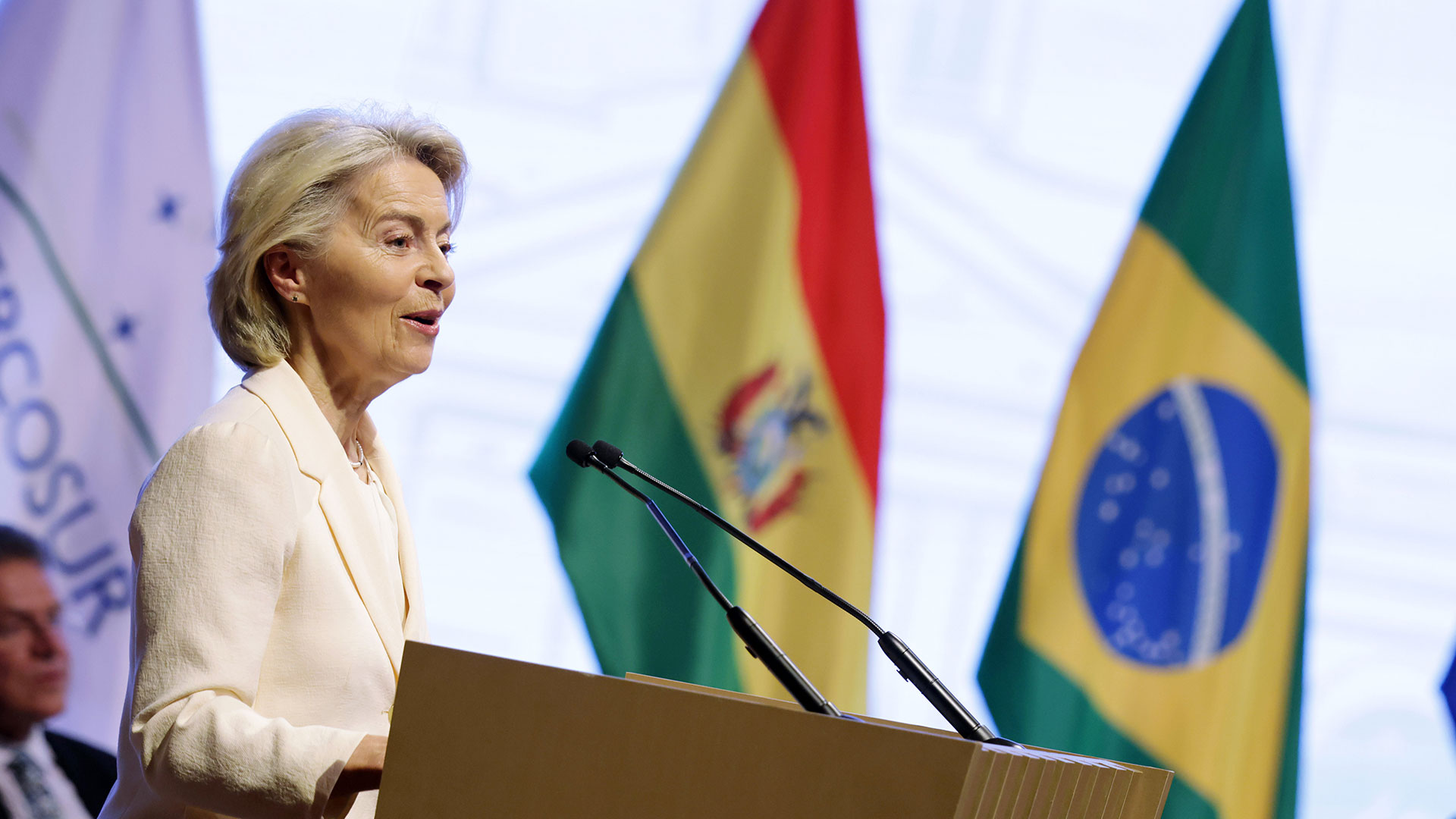
Nevertheless, the EU still struggled to ratify the Agreement. Immediately after Von der Leyen travelled to Paraguay to formally sign the Agreement, the Parliament deferred it for its revision to the Court of Justice, an action that could delay its enactment for almost two years. An agreement between extreme right and left-wing parties dealt a strong hit to the Von der Leyen Commission by making explicit the EU’s difficulties in acting decisively and showing itself as a trusted counterpart. In contrast, the South American bloc has exhibited a strong will to ratify the agreement despite European setbacks. Argentina and Uruguay have already ratified it with sweeping majorities, and Brazil and Paraguay will vote on it in the following weeks with no foreseen difficulties.
The contrast between Mercosur and the EU could not be more striking. Whereas in South America parties across the political spectrum provided a transversal support to the Partnership, creating an easy path for its approval, European parliamentarians have united to protect the interests of the agricultural sector that contributes roughly 1% to the EU’s GDP while receiving roughly one-third of the EU’s budget in subsidies. If Europe has been a difficult counterpart to negotiate with, then why is Mercosur still insisting on doing so?
Europe’s soft power
The stark differences between the ratification processes of the two blocs reveal the considerable soft power -understood as the power of attraction- the EU still holds in its foreign policy. Mercosur has accommodated the numerous safeguards demanded by the EU, ranging from ecological and sustainability to quotas to South Americans’ top exports -beef, poultry, sugar, and ethanol- to allowing the entry of value-added goods to their markets that will greatly benefit the European lagging industrial sector. Mercosur agreed on measures that were directly counter to its trade interests. Therefore, the South American bloc's willingness to sign this Agreement despite the many obstacles set by Europeans cannot be explained solely in terms of economic benefits. If this were the case, the Agreement would have been rejected.
Mercosur’s attitude is also explained by the symbolic power of signing a free trade agreement with the EU. Creating one of the largest free trade areas and gaining access to the massive European market provides a much-needed renewed push to Mercosur. It allows the bloc to show that, despite obstacles, it is still capable of signing an agreement with what is most certainly the most successful project of regional integration in the world, and that it can adapt to an increasingly menacing global order. With the trade bloc mired in stagnation and rife with decades-long tensions among its members, the Agreement with the EU is fundamental to the South American bloc's repositioning on the international stage.
The EU has successfully leveraged its soft power to include its many safeguards and still enjoy Mercosur’s excitement with the Agreement. However, the EU cannot keep riding solely on this. If Brussels wants to show Latin America and the world that it can be a trusted counterpart capable of sustaining the multilateral order and free trade, it needs to act swiftly. Brussels being hostage to farmers’ lobbies erodes the credibility of the EU as a reliable partner and defender of the global rules-based order in times of profound questioning.
Looking forward, the EU needs to stop relying excessively on its soft power in Latin America and surmount its internal obstacles that constrain an assertive foreign policy. The resilience of the EU and its overall security in times of increasingly straining Trans-Atlantic relations and tensions with China relies on the maintenance of the global rules-based order, and for this, it cannot act alone. In this lane, the Commission’s decision to provisionally enact the Agreement despite the resistance from MEPs is the right choice to signal that the EU can be act with swiftness.
In conclusion, it is imperative for Brussels to prioritize speaking to the hearts and minds of its Latin American counterparts and provide them with the reassurance that the EU can be a reliable partner, leveraging its soft power advantage. Where the EU fails to do so, middle powers will draw closer to actors they could deem as potentially more trustworthy and less convoluted, as shown by Brazil’s sudden openness to advance on a China-Mercosur Trade Agreement that it has long resisted.
Salvador Lescano is a master’s student at the EUI’s Florence School of Transnational Governance. His current research focuses on global order transformation, normative security, resilience-building, like-mindedness, and EU-Latin America relations. His articles have been featured in several outlets, including The Diplomat, Global Americans, NACLA, and Letras Libres, amongst others.