Author:

Mention Carlo Ginzburg at the EUI and you will be met with either a blank stare or a fond smile, often followed by an anecdote. His best-known work, The Cheese and the Worms (Il formaggio e i vermi, 1976), is a foundational text of microstoria (microhistory), a field that revolutionised Italian historiography in the 1970s and 1980s. On Tuesday, 16 June 2026, the prominent Italian historian died in Bologna at the age of 87.
Carlo Ginzburg at EUI
For decades Ginzburg’s name and works have circulated through history seminars, lectures and workshops at Villa Schifanoia and Villa Salviati. He was quite a frequent guest at the EUI: In 2008, he lectured on terror and Hobbes within the Max Weber Fellowship Programme. He later joined a workshop on judges and historians and in 2014 he was awarded the EUI’s Doctor Honoris Causa. To remember him also means continuing to introduce his diverse, multidisciplinary work to new generations of researchers.
Thanks to Ginzburg, I realised that it is possible to write history about common people – and that this helps us understand the past more than any biography of a king or battle stories. — Alejandro Salamanca Rodríguez, HEC PhD Researcher
Beginnings and career
Carlo Ginzburg was born in Turin in 1939 to Natalia (née Levi), a prominent writer, and Leone Ginzburg, a Jewish philologist and co-founder of the publishing house Einaudi. During the 1940s, under fascist racial laws, the family moved from Torino to Abruzzo and then to Roma. Leone, an antifascist activist, was arrested, tortured, and died in prison in 1944. Natalia eventually returned to Torino with her children before remarrying and moving again to Roma. Alongside the literary environment shaped by his mother, Ginzburg later recalled deciding his vocation in a university library:
[A]vevo vent’anni. Mi trovavo nella biblioteca della Scuola Normale a Pisa e decisi tre cose: che volevo fare lo storico; che volevo studiare i processi di stregoneria; e che volevo studiare non i meccanismi di persecuzione ma i perseguitati.
Ginzburg studied at the Università di Pisa, the Scuola Normale Superiore, and the Warburg Institute in London, completing his PhD in 1961. He later taught in the United States at Harvard, Princeton, and UCLA, before returning to Italy in the early 2000s, particularly to the Scuola Normale. Ginzburg consistently published first in Italian, with translations following in multiple languages. The EUI Library holds first editions as well as translations in English, French, German and Spanish.
Ginzburg's research and works
Before The Cheese and the Worms, which reconstructs the trial of the miller Menocchio accused of heresy, Ginzburg had worked on witchcraft trials and shamanistic cults, topics to which he returned throughout his career. Ginzburg’s work focuses on the misunderstood, the marginal, the exceptional: the “worm in the cheese”. Alongside Giovanni Levi, he is considered a founder of microhistory, an approach that uses small-scale evidence to explore broader historical questions. His extensive archival-based work foregrounded ordinary and marginalised individuals to illuminate wider processes of change.
On display in the entrance of the Library you will see the first edition of Storia notturna: una decifrazione del sabba published with Einaudi in 1989 and the third paperback edition of Ginzburg’s first book I benandanti: Stregoneria e culti agrari tra Cinquecento e Seicento (1979 [1966]) also with Einaudi.
The rebound 1979 edition of I benandanti on display, comes in a handy pocket-sized paperback format. The small format invites us to consider how this pathbreaking work quickly became a staple and affordable university reading. Expanding the theories and discoveries of I benandanti, Storia notturna argues more broadly that ancient popular beliefs had a long-lasting influence on what in the early modern period was bedevilled as ‘witchcraft’.
Of great influence for this argument were the ecstatic shamanic rituals of the Eastern Iranian Scythians, an equestrian nomadic people that migrated as far as today’s Ukraine. The practices were linked to later phenomena like the Wild Hunt and the Witches’ sabbath by Ginzburg and others. This connection is prominently visible through the golden comb displaying Scythian riders in combat on the cover of Storia notturna.
Drawing from his wide-spanning, rich archival and literary research, Ginzburg had a great impact on the method of history too. My own first encounter with Ginzburg was in an EUI cultural history seminar. Reading Clues: Roots of an Evidential Paradigm, I was struck by his narrative (enchanting even in translation!) as it moved effortlessly across time and space. Ginzburg challenged rigid distinctions between rational and irrational, advocating instead for a method that embraces intuition, conjecture, and close attention to lived experience.
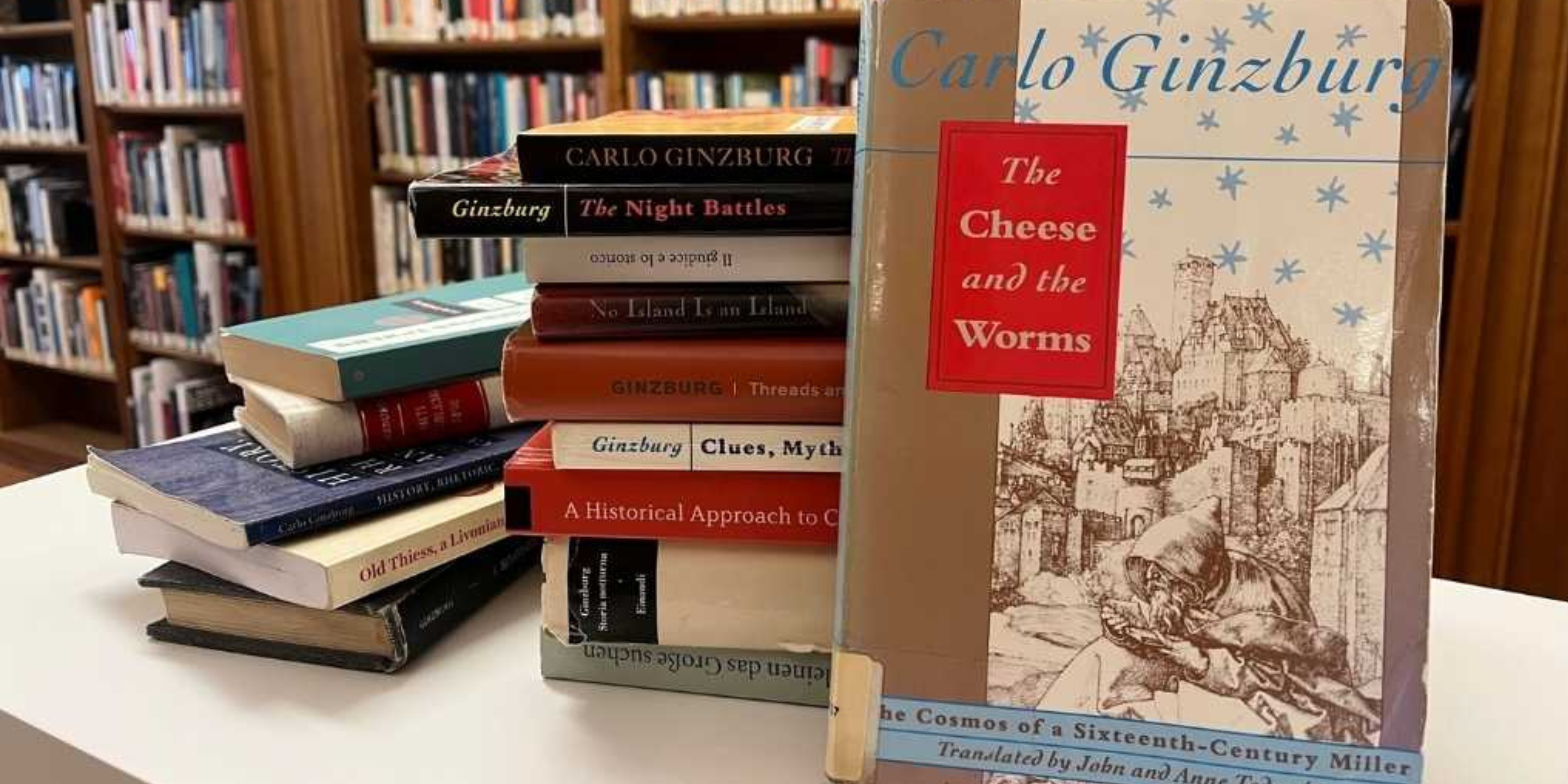
Display and featured collection at the EUI Library
Ginzburg’s wide-ranging interests spanned Antiquity, Renaissance and early modern Europe and Eurasia more broadly, with an interdisciplinary engagement in art history, literature, and theory. Assembling the accompanying library display meant traversing all three floors of the EUI Library. Alongside his works, the featured collection in the EUI Library catalogue includes classics and new interpretations of microhistory, from Natalie Zemon Davis to the recent Microstoria e storia globale by Francesca Trivellato.
The temporary display and the permanent online collection aim to sustain both the memory and the intellectual legacy of a captivating scholar, remembered for his sometimes-grumpy comments and dismissals but also fondly admired for the ‘most amazing eyebrows’.
Browse and borrow from the Carlo Ginzburg featured collection.
The language of the original text and its length were enhanced and shortened using Microsoft Co-Pilot. The author has checked and adapted the output further.