Author:

- Exhibition title: Global Florence: Discovering Francesco Carletti's travels at the EUI Library
- Associated event: Global Florence. The World of Francesco Carletti at the Biblioteca Medicea Laurenziana, Global Florence: The Making of an Exhibition roundtable at the Kunsthistorisches Institut in Florence, Global Knowledge ca. 1600: The View from Florence and Milan at the Kunsthistorisches Institut in Florence
- About the Researcher: Professor Giorgio Riello
- Exhibition dates: 1 to 28 October 2026
- Location: EUI Library, Stockholm room, first floor
Overview
The exhibition introduces Francesco Carletti, a Florentine merchant who travelled around the world between 1594 and 1602. Following his journey from Florence through Europe, Africa, the Americas and Asia, it traces the people, commodities, objects and knowledge that connected Florence to an expanding world at the turn of the seventeenth century. Carletti’s experiences provide a lens through which to explore how Florentines perceived and made sense of distant places. Rather than presenting him as an exceptional figure in isolation, the exhibition situates his story within wider networks of commerce, collecting and knowledge, showing how engagement with the wider world reshaped the city while also reflecting the violence, exploitation and imperial expansion that sustained it.
Development
The display accompanies Global Florence: The World of Francesco Carletti, ca. 1573–1636, the major exhibition at the Biblioteca Medicea Laurenziana (9 October 2026–9 January 2027), curated by Professor Giorgio Riello (EUI), Professor Brian Brege (Syracuse University), and Professor Paula Findlen (Stanford University), with an interdisciplinary advisory board of historians, art historians, librarians and curators. The EUI Library display was developed in collaboration with Professor Giorgio Riello, the Department of History, the Biblioteca Medicea Laurenziana and the EUI Library, and features images selected from the exhibition catalogue.
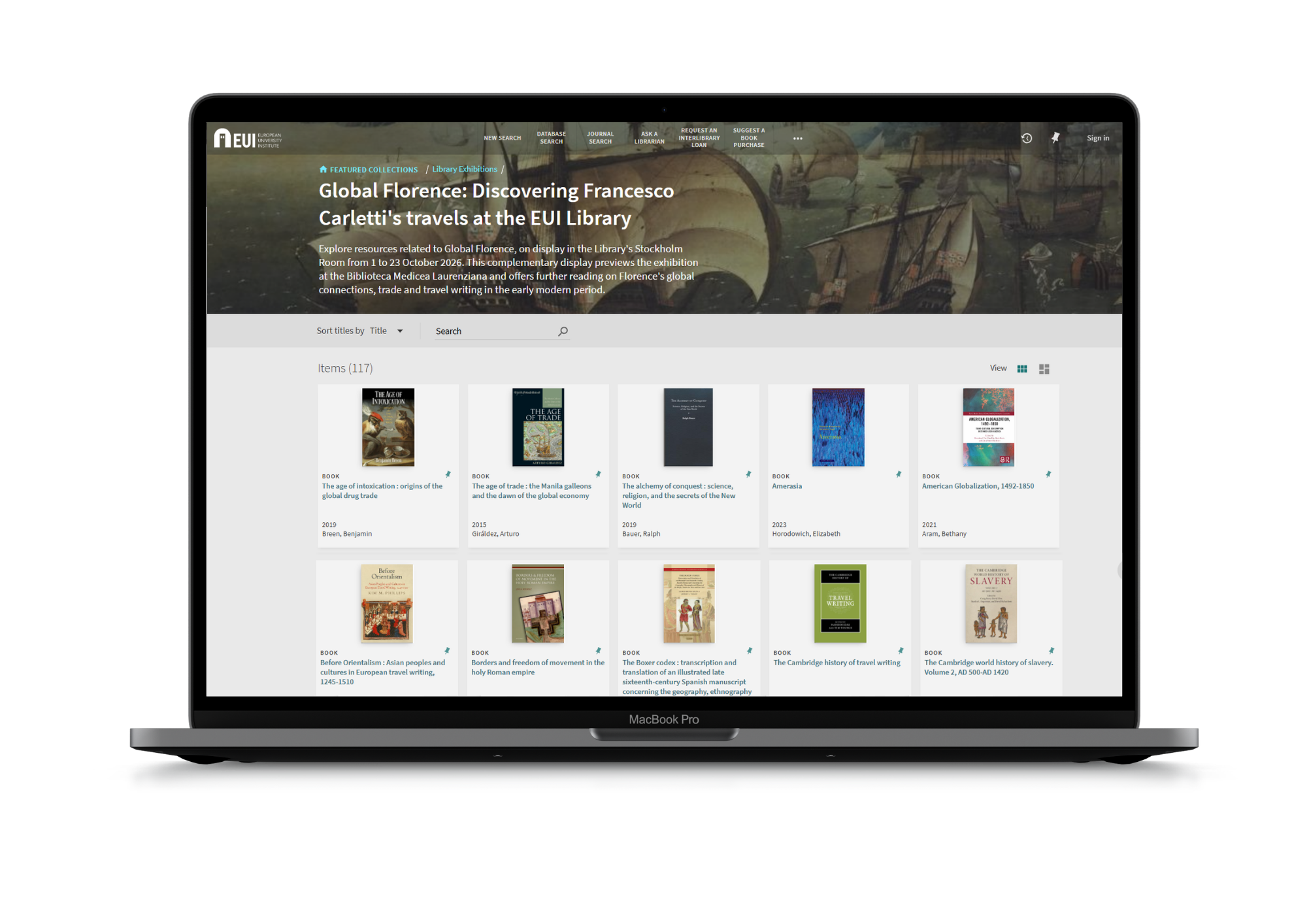
Browse and borrow from a curated selection of books from the EUI Library collection for this event. The exhibition builds on the collaborative volume Trading at the Edge of Empires: Francesco Carletti’s World, c. 1600, co-edited by Giorgio Riello, Brian Brege, Paula Findlen and Luca Molà. Drawing on Carletti’s travel account, the book uses his experiences not to present him as a hero, but as a witness to a world shaped by trade, empire, slavery, religion and cultural exchange. In his #EUIResearch interview, Professor Riello discusses the book and the questions it raises about Carletti, his world, and Florence’s relationship with the wider world.
Key message
Florence is often associated with the Renaissance, but its history extends far beyond Italy. Carletti’s journey invites us to see how distant places, people and cultures shaped the city – and to consider the inequalities and violence embedded in these connections.
Exhibition image descriptions
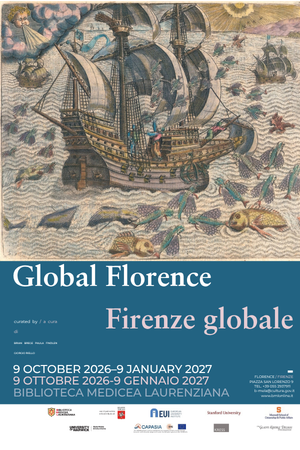
The poster chosen for Global Florence features Theodore de Bry’s Flying Fish Meet in the Torrid Zone, a coloured engraving published in 1592 as part of Americae Tertia Pars. The image depicts a sailing ship surrounded by flying fish in the tropical seas, combining maritime observation with the sense of wonder and curiosity that characterised European representations of distant worlds.
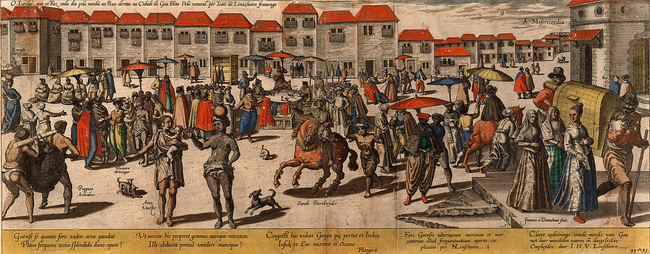
This engraving by Dutch traveller Jan Huygen van Linschoten depicts the bustling Rua Direita, one of the principal streets of Portuguese Goa, with merchants, residents and visitors moving through the city. It offers a visual impression of the cosmopolitan port where Carletti stayed for eighteen months, and which he described as a place where “one can live better and more regally.”
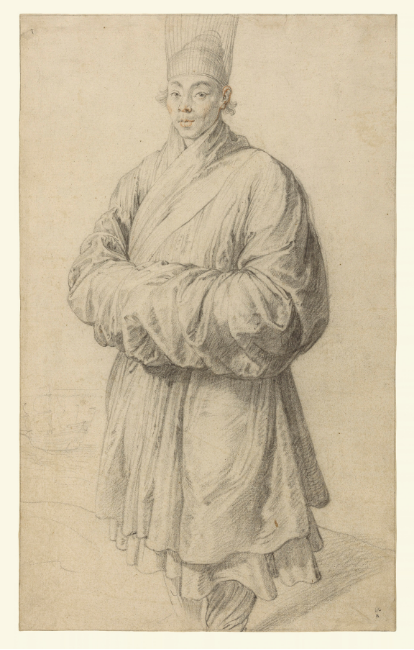
This striking drawing of a man in Korean dress was made in Rubens’s Antwerp studio and circulated widely in Europe. The man depicted has long been associated with Antonio Corea, a Korean man purchased by Francesco Carletti in Nagasaki and taken with him to Florence. Antonio was probably the first Korean known to have reached Italy. Although the sitter’s identity remains uncertain, the portrait offers a compelling visual link to Carletti’s story and to the early movement of people and knowledge between Korea, Japan, and Europe.
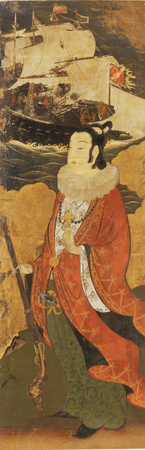
This detail from a Nanban screen features a young Japanese convert wearing European-influenced Nanban attire, including a pendant Christian cross around his neck. A Portuguese ship can be seen in the background, evoking the maritime networks through which merchants and missionaries reached Japan. Carletti arrived in Nagasaki in 1597, at a moment when the Christian mission was flourishing but already facing persecution. There, he witnessed the crucifixion of six Franciscan missionaries and twenty Japanese Christians. At the same time, he marvelled at Japan’s craftsmanship and refined lifestyle, describing it as “one of the most beautiful, good, and favorable countries for profiting” in the world.
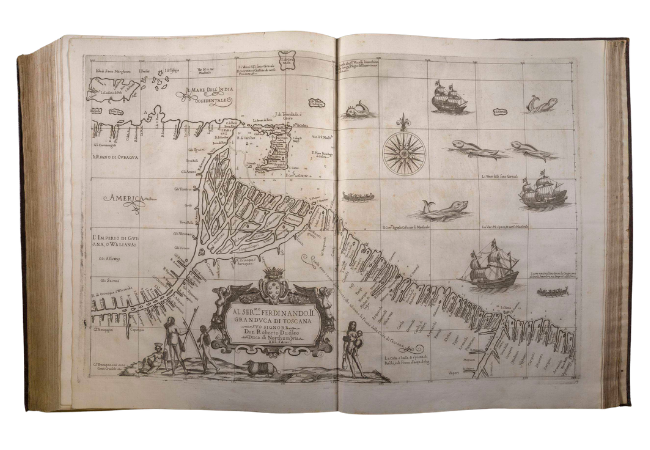
This map of the northern coast of Brazil comes from Sir Robert Dudley’s monumental maritime atlas, dedicated to Ferdinando II de’ Medici. An English explorer, engineer and cartographer who settled in Florence in 1605, Dudley served the Medici court and contributed to its maritime ambitions. The map reflects Florence’s interest in distant territories, which had inspired a Tuscan expedition to northern Brazil under Ferdinando I in 1608. Carletti, a man of the Medici court, later sponsored the baptism of the expedition’s sole surviving Amerindian captive, named Giovanni after Florence’s patron saint.
Acknowledgments
With thanks to Professor Giorgio Riello, the Department of History, the Biblioteca Medicea Laurenziana and the EUI Library for their collaboration in developing this display, and to the Global Florence exhibition team for making its materials available.